Dear friend, are you struggling to choose the right awning?
Spring has quietly arrived, and awnings have become an indispensable architectural element, whether for family balconies, courtyards, or shop entrances. They not only effectively block UV rays and lower indoor temperatures, but also expand outdoor living space and provide protection for your car or outdoor furniture.
However, faced with the dazzling array of awning products on the market, many consumers often find themselves in a dilemma. Hiway, an outdoor furniture supplier, offers you a practical buying guide.
Main Types and Advantages/Disadvantages of Awnings
Awnings can be mainly divided into the following types:
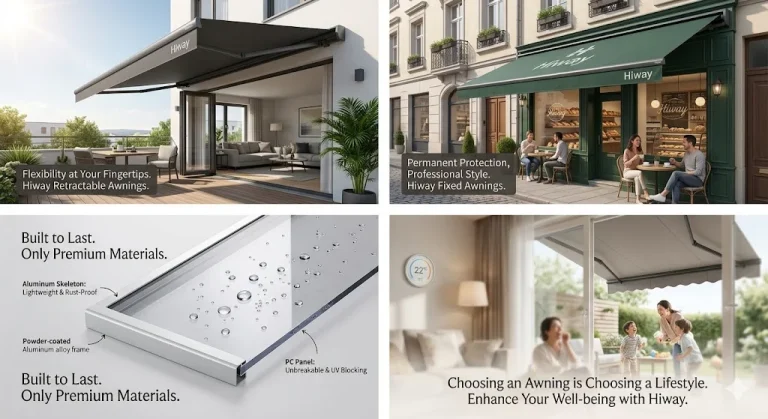
Retractable Awnings (Manual/Electric):
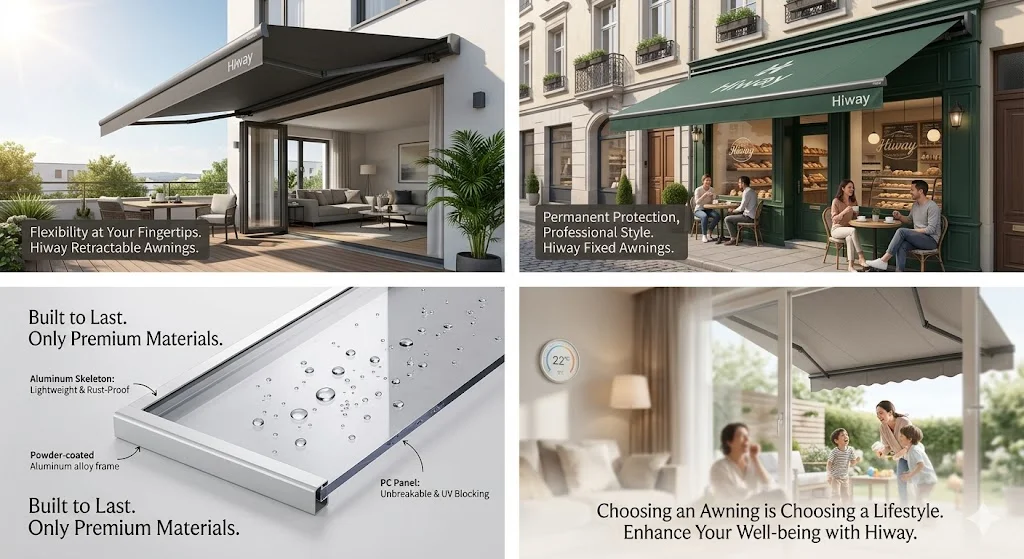
This is currently the most popular type in the home market, especially suitable for balconies and windows. Driven by a motor or hand crank, the opening angle of the awning can be adjusted freely (usually 0-130 degrees).
- Advantages: High flexibility; unfold on sunny days and retract on cloudy days or at night, without affecting indoor lighting or views. Electric models, equipped with wind, light, and rain sensors, can achieve automatic retraction and opening, making them convenient to use.
- Disadvantages: Relatively weak wind resistance; must be retracted promptly in strong winds, otherwise the frame or fabric may be damaged. Additionally, the lifespan of fabric is shorter than that of rigid panels.
Fixed Awnings: Typically use an aluminum alloy frame combined with polycarbonate (PC) panels or endurance boards, providing a stable structure and permanent installation above doors, windows, or terraces.
- Advantages: Stable structure, high durability, and long-term resistance to wind and rain. The awning panels usually have excellent impact resistance; some products claim to withstand category 12 typhoons.
- Disadvantages: Lacks flexibility; once installed, it is difficult to adjust the angle or disassemble, which may affect winter lighting needs to some extent.
Folding/Skylight Awnings: Commonly seen in backyard camping or temporary stalls, similar to large outdoor umbrellas or simple tents. Folding louvered roofs are also used in high-end sunrooms
- Advantages: Lightweight and easy to store; can be folded for storage when not in use, saving space.
- Disadvantages: Limited shading range, weak wind resistance; primarily used for temporary or seasonal sunshade.
Window-type awnings: Installed above and on the outside of windows to specifically block direct sunlight from entering the room; typically smaller in size and available in various styles.
Balcony/terrace awnings: Larger in area, requiring functions such as sunshade, rain protection, and even security; commonly available in retractable or fixed types.
Pavilion awnings: Often combined with grape trellises, or using membrane structures or aluminum louvered roofs, emphasizing aesthetics and ambiance.
Awning Materials Revealed
The performance of an awning is primarily determined by two core components: the frame material and the shading surface material.
Frame Material
The frame is the “skeleton” of the awning, determining its stability and lifespan.
- Aluminum Alloy: Currently the mainstream choice in the market. Advantages include lightweight, high strength, and corrosion resistance. After electrostatic powder coating, its oxidation resistance can reach over 30 years. Aluminum alloy is the preferred choice for home users, ensuring both lightweight design and avoiding the risk of rust.
- Stainless steel: Higher strength than aluminum alloy, stronger load-bearing capacity, and excellent corrosion resistance. Suitable for large awnings or harsh environments such as the seaside and humid areas, but relatively expensive and heavier.
- Galvanized steel pipe: Inexpensive and strong load-bearing capacity. However, its disadvantage is that it is prone to rust if the surface coating is damaged, requiring regular maintenance. It is often used in temporary structures or low-budget projects.
Shading Surface Material
This is the “skin” of the awning, directly determining its shading effect and durability.
- Polycarbonate sheet (PC board/endurance board): Commonly used in fixed awnings. Advantages include extremely high impact resistance (approximately 200 times that of glass), good light transmittance (some sections can reach 89%), and a UV layer added through double-sided co-extrusion, effectively blocking over 98% of ultraviolet rays. It has strong weather resistance and can be used for extended periods in environments ranging from -30℃ to 60℃, but noise issues in rainy weather need attention.
- Acrylic fabric/PVC coated fabric: Commonly used in retractable awnings. These fabrics offer excellent waterproof and anti-aging properties, high colorfastness (high-quality acrylic fabric can guarantee no fading for 5 years), and a certain degree of self-cleaning ability. It is recommended to choose fabrics with the darker side facing outwards for better heat absorption and reduced fabric aging.
- Polyester/Oxford Cloth: Primarily used in economical or temporary sunshade products. Affordable, but its tear resistance and anti-aging properties are not as good as acrylic fabric. If it has a black coating, the sun protection factor (UPF) can reach 50+, suitable for outdoor umbrellas.
- Membrane Structures (PVDF/PTFE): Primarily used in large public buildings or high-end courtyards. Lightweight, high-strength, with good light transmission, excellent self-cleaning properties, and a lifespan of 15-30 years. It can reflect a large amount of heat.
Three or Four Purchasing Tips
Based on Usage Scenarios and Functional Needs
- Home Balconies/Window Window: Retractable motorized awnings are recommended. If the balcony faces west or due south, there is a strong need for heat insulation in summer, and flexible light adjustment is required. A motorized retractable awning with a wind and rain sensor provides an excellent experience. If you live on a lower floor and prioritize security and sound insulation, a fixed PC panel awning is a good option.
- Ground floor courtyard/villa terrace: Fixed aluminum alloy + PC panel or motorized louvered awnings are recommended. These two structures are stable and can create a permanent outdoor leisure area. For aesthetic appeal and light and shadow effects, a combination of wooden lattice and greenery can be considered; although maintenance is slightly more troublesome, the natural feel is irreplaceable.
- Shop entrance: Heavy-duty retractable awnings are recommended. It is suggested to use anti-aging, waterproof acrylic fabric and print the shop logo, combining practicality and advertising effect.
Size Selection Guide
When measuring, the awning’s coverage area should be slightly larger than the area to be shaded.
- Width: It is recommended to be 20-30 cm wider than the width of doors, windows, or balconies to block oblique sunlight.
- Height: The installation height of the awning should not be too low; it is generally recommended to be no less than 2.2 meters from the ground to avoid a feeling of oppression and ensure safe passage.
- Precautions: For retractable awnings, the width of a single panel should not exceed 3 meters, and the height should not exceed 3 meters. Exceeding these limits requires consideration of segmented installation or special reinforcement.
Accessories and Craftsmanship
- Drainage Pipe Design: High-quality fixed awnings feature unique drainage pipe designs to prevent rainwater from falling directly from the edges of the awning and causing “secondary pollution.” The structure is also designed for easy cleaning.
- Fabric Connection Process: High-frequency welding, rather than simple sewing, should be used at the fabric seams of retractable awnings to ensure sufficient strength and prevent tearing.
- Operating System: When choosing an electric model, be sure to confirm the motor brand and warranty period. If possible, install wind and rain sensors, which are crucial for the protection of the retractable awning.
Safety and Aesthetics
- Wind Resistance: Residents of high-rise buildings need to pay special attention. Although manufacturers claim typhoon resistance, the actual installation must be secure, and screws should be checked regularly. For high-rise buildings, property management may sometimes prohibit the installation of retractable awnings; this must be confirmed in advance.
- Aesthetics and Harmony: The color and shape of the awning should coordinate with the building’s facade. For a modern minimalist style, choose gray, black, or white aluminum alloy or PC panels; for a rustic style, choose fabric retractable awnings or wooden elements.
Avoidance Guidelines and Maintenance Suggestions
1. Avoidance: Don’t just look at the price. Extremely cheap products often use inferior fabrics (prone to fading and tearing) and thin-walled frames (prone to deformation). When purchasing, choose reputable brands and request to see material testing reports (such as UV blocking rate and wind pressure resistance).
2. Installation: Have it installed by a professional. Improper installation is the main cause of leaks, loosening, and detachment. The awning roof should maintain a 3-5 degree tilt angle for drainage.
3. Maintenance:
- Retractable Fabric: Clean debris quarterly and wipe stains with a neutral detergent. If not used for a long time, it is recommended to roll it up to extend the fabric’s lifespan.
- PC Panels/Endurance Boards: Avoid scratching with hard objects; simply rinse with water. Check the sealant at the joints for aging and cracking. Choosing an awning is essentially choosing a lifestyle. Whether you’re looking for a UV-free reading nook or a summer party in your yard, a suitable awning can greatly enhance your well-being. When choosing an awning, first decide on the type (fixed or flexible), then consider the material (durable or economical), and finally, carefully measure the dimensions to match your needs. Hopefully, this will help you find that perfect shade for yourself and your family before summer arrives.